

Bitcoin Isn’t the Climate Problem — The Power Grid is
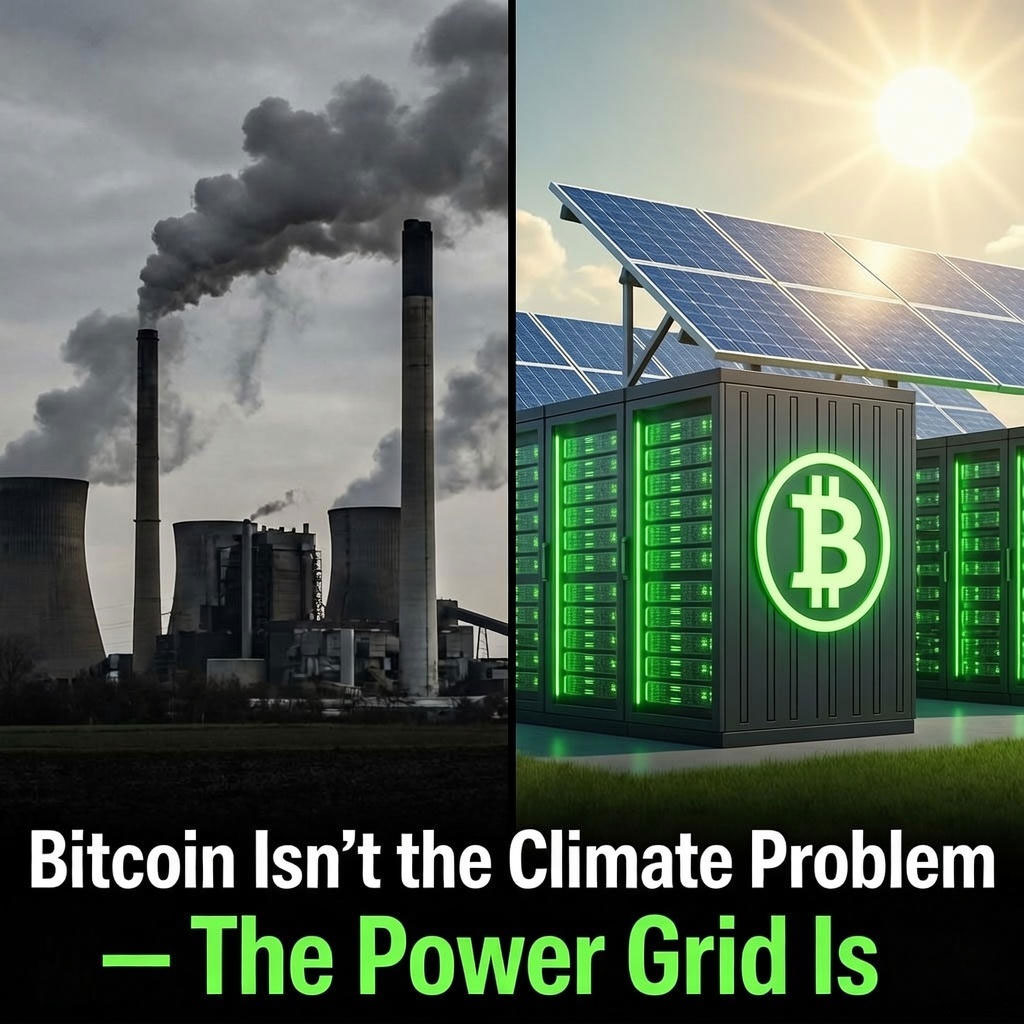
The debate around Bitcoin’s climate impact is often misleading: Bitcoin itself isn’t the climate problem — the power grid is.
One system wastes clean energy at scale. The other exposes that waste.
Bitcoin didn’t become the climate villain because of science. It became the villain because it’s convenient.
Blaming Bitcoin mining for climate damage allows institutions, regulators, and corporate sustainability departments to avoid confronting a far more uncomfortable truth: our power grid is structurally incapable of handling clean energy abundance—and it wastes enormous amounts of it every year.
Bitcoin mining didn’t invent renewable energy waste. It revealed how deeply embedded that waste already is in a rigid system built for fossil fuels, not flexibility.
The Power Grid’s Dirty Secret: Wasted Clean Energy
Wind and solar are not failing technologies. They are victims of an outdated grid.
As renewable capacity expands—especially in remote or rural regions—electricity production increasingly exceeds what transmission systems and local demand can absorb. When that happens, grid operators must curtail generation by intentionally shutting off wind turbines and solar farms.
Curtailment is not theoretical. It is routine in places like West Texas and parts of China, where clean electricity is available but cannot be delivered profitably or reliably. The consequences are systemic:
- Renewable developers lose revenue
- Investors demand higher returns or walk away
- New projects are delayed or canceled
- Fossil fuel plants remain online “for reliability”
This is not a failure of renewables. It’s a failure of grid design and market structure.
Bitcoin Climate Impact vs Grid Waste
Bitcoin mining uses electricity. That fact is not in dispute.
What rarely receives equal scrutiny is this: the power grid discards clean electricity at scale because it cannot adapt to variable supply. Wind and solar are punished for producing too much energy, while fossil fuel plants are rewarded for constant output—even when demand doesn’t justify it.
If wasting clean energy were treated with the same urgency as consuming energy, the climate conversation would look very different.
Bitcoin didn’t create this contradiction. It simply made it visible.
Bitcoin Mining Does What the Power Grid Can’t
Bitcoin mining is not inherently green, and it is not a climate cure. But it has one characteristic the modern grid desperately lacks: flexibility.
Mining equipment:
- Can operate wherever electricity exists
- Can shut down quickly when power is needed elsewhere
- Does not require continuous uptime to function
When market rules allow, this makes Bitcoin mining a buyer of last resort for electricity that the grid cannot absorb. During periods of excess wind or solar generation, mining can consume surplus power. When demand rises, that load can be curtailed.
This is not a replacement for transmission upgrades or energy storage. It is a demand-side tool that can reduce waste in systems where curtailment is already occurring.
Bitcoin mining doesn’t fix the grid. However, it exposes where the grid refuses to adapt.
Why the Power Grid Can’t Battery Its Way Out
Every discussion of renewable curtailment eventually lands on the same answer: build more batteries.
Grid-scale batteries are essential infrastructure. But pretending they are the only solution ignores reality.
Large chemical storage systems are:
- Capital-intensive
- Material-heavy (lithium, cobalt, nickel)
- Slow to permit and deploy
- Not always economically viable in rural regions
Batteries store energy. Bitcoin mining does not.
What mining can do—when paired with stranded renewables—is convert surplus electricity into immediate economic value. That revenue can:
- Improve early-stage project economics
- Reduce financing risk
- Accelerate renewable build-out in underserved areas
This is not ideology. It is project finance.
How a Broken Power Grid Fails Rural Communities
The centralized grid consistently under-serves rural regions. Transmission is expensive. Demand is low. Returns are uncertain.
Flexible energy demand changes that equation.
By co-locating renewable generation with flexible computing loads, developers can monetize energy that would otherwise be curtailed. This can make projects viable sooner and keep revenue local rather than exporting it to distant utilities.
While this doesn’t guarantee prosperity, it provides rural energy projects with leverage that the traditional grid rarely offers.
Methane Flaring: The Hypocrisy Test
Bitcoin critics often point to mining operations powered by fossil fuels while ignoring the reality of methane flaring.
Methane is more than 80 times more climate-damaging than CO₂ over a 20-year period. When flared gas is converted into electricity instead of burned into the atmosphere, near-term emissions decline.
This is not a free pass for fossil fuel extraction. It is harm reduction.
Calling Bitcoin mining “dirty” while tolerating routine flaring is climate theater, not climate strategy.
ESG Blames Bitcoin to Avoid Fixing the Grid
Bitcoin mining doesn’t fit neatly into Environmental, Social, and Governance (ESG) frameworks. It doesn’t rely on offsets. It doesn’t ask permission. And it doesn’t hide behind accounting tricks.
What it does is highlight an uncomfortable reality:
A system that wastes clean energy at scale is not sustainable—no matter how many reports say it is.
The real climate question isn’t “How much energy does Bitcoin use?”
It’s:
Why does the grid throw away clean energy while fossil fuel plants stay protected?
The Line in the Sand
Bitcoin mining is not a universal solution. Used irresponsibly, it can absolutely increase emissions.
But in grids already suffering from renewable curtailment, stranded energy, and inflexible demand, Bitcoin mining can function as a pressure test—revealing inefficiencies the system has long ignored.
The climate debate around Bitcoin is backwards.
We are arguing about who is using electricity while refusing to confront who is wasting it.
Bitcoin isn’t the climate impact problem. The power grid is.
We are currently wasting massive amounts of clean energy because our centralized grids are too rigid to handle the surge of wind and solar power. According to the International Energy Agency grids must be modernized and expanded to handle growing renewable output, or the world risks stalling progress toward net-zero emissions.
Compliance Note: The content within this article is curated and vetted by the Swap The Toxins editorial team. We align with the strict standards of our product experts.

Liam Chen
Liam Chen is a contributing writer for the Swap The Toxins Team, focused on supply chain transparency and ingredient accountability. His work explores how manufacturing practices and corporate decisions impact both human health and the environment. This article was created using AI-assisted research and reviewed by the Swap The Toxins editorial team.
Frequently Asked Questions
Is Bitcoin bad for the climate?
Bitcoin uses energy, but its climate impact depends on energy source, grid conditions, and regulation. In many regions, the larger issue is renewable energy waste caused by grid inflexibility.
Why does the power grid waste renewable energy?
Transmission constraints, market design, and inflexible demand force operators to curtail wind and solar when supply exceeds what the grid can handle.
Does Bitcoin mining solve climate change?
No. It can reduce waste or flaring in specific contexts, but it does not replace grid upgrades, storage, or decarbonization.
Continue Your Non-Toxic Swap Journey…
Ready to transform more areas of your life? We have comprehensive guides for both home and body product categories, plus our non-toxic gifting hub:
- Non-Toxic Home Swaps: See vetted reviews for Non-Toxic Home Swaps for a cleaner living space.
- Non-Toxic Body Swaps: See vetted reviews for your Non-Toxic Body Care routine
- Clean Beauty Swaps: Discover safer alternatives for your makeup bag with our Non-Toxic Cosmetics Guide.
- The Non-Toxic Gift Guide Hub: Explore our curated selections for every occasion, ensuring your high-value gifts are always safe and sustainable.
- For Our Full Library: Explore all articles, guides, and insights in the Swap The Toxins Blog.