
Stop Applying Cancer Risk Chemicals: Best Toxin-Free Moisturizers
It’s time to stop compromising. The best non-toxic Moisturizer is the one that offers complete safety without sacrificing performance.
Disclosure: As an Amazon Associate, we earn from qualifying purchases made through links in this post at no extra cost to you.
When I was an environmental health researcher, I spent years studying how chemicals move from products into human tissue. And I can tell you this: specifically, your Face Moisturizer is one of the most direct and concerning routes for chemical absorption into your body. Your facial skin is thinner, more sensitive, and rich in blood vessels. Consequently, it has a higher capacity to absorb whatever you put on it, including chemicals that form an alarming moisturizer cancer risk.
This isn’t about cosmetic results; instead, it’s about systemic health. I view a conventional Facial Moisturizer as a Trojan horse. It promises hydration and anti-aging, but it often delivers a daily dose of ingredients. These ingredients are designed not to nourish, but simply to sit on the surface, block pores, and interfere with your skin’s natural, intelligent barrier function. Furthermore, the industry profits by masking your skin issues rather than resolving them. It’s time to look past the marketing and confront the chemical reality.
🔬 The Data on Daily Dosing: Ingredients to Eliminate Now
The primary function of a Facial Moisturizer should be to support the skin’s lipid barrier, helping it retain moisture naturally. Instead, many conventional products rely on sealing ingredients that essentially suffocate the skin. They also use a lineup of preservatives and emulsifiers that are actively linked to irritation and endocrine disruption. I’m especially concerned about the cocktail effect—the cumulative exposure from using multiple products every single day.
When I analyze an ingredient list, I’m looking for clear, non-negotiable red flags that have a documented impact on long-term health:
- BHA and BHT: These synthetic antioxidants often serve as preservatives. They are known potential endocrine disruptors. Furthermore, some international bodies classify them as possible human carcinogens – a real moisturizer cancer risk.
- Petroleum and Mineral Oil (Paraffinum Liquidum): These are byproducts of crude oil distillation. While they are highly effective sealing ingredients, they do not nourish skin. The concern is that PAHs (Polycyclic Aromatic Hydrocarbons) can contaminate them, and PAHs are my second moisturizer cancer risk.
- Retinyl Palmitate (Vitamin A Derivative): While Vitamin A is good, studies suggest that when applied to skin and exposed to sunlight, Retinyl Palmitate may break down into free radicals. Consequently, this potentially damages DNA and leads to faster skin tumor development.
- Synthetic Fragrance/Parfum: This is an umbrella term that can hide hundreds of chemicals, including phthalates, which are well-established endocrine disruptors linked to reproductive issues and developmental problems. Therefore, this is a non-negotiable elimination for me.
🚫 Stop ‘Greenwashing’ Your Face: What Your Skin Really Needs
A major source of confusion for consumers is the term “non-comedogenic.” This label simply means the product is less likely to block pores. However, it offers zero guarantees about the safety or cleanliness of the ingredients used. Furthermore, many “sensitive skin” formulas are just as chemically problematic as the main line. This deliberate use of soft marketing language to distract from hard chemical data is the kind of greenwashing that frustrates me most.
You don’t need a complex serum-layering ritual; you need a simple, targeted swap that respects your skin’s biological design. I recommend focusing on products that contain ingredients that mimic your skin’s natural moisture factors. These are the fatty acids and ceramides that your body uses to maintain a healthy, resilient barrier.
My research has shown that the most effective and safest non-toxic moisturisers share key attributes:
- Rely on Whole Plant Oils/Butters: Look for organic Jojoba Oil, Shea Butter, or Argan Oil. These are rich in beneficial fatty acids and are structurally similar to human sebum.
- Prioritize Skin-Identical Ingredients: Ceramides and Hyaluronic Acid are natural components of healthy skin. Additionally, they aid in repair without disrupting your body’s chemistry.
- Use True Essential Oils (or be fragrance-free): If a scent is present, it should be derived from clearly labeled essential oils, not proprietary parfum. If you have sensitive skin, opt for completely fragrance-free.
- Pass the “Food Grade” Test: While not a literal requirement, I prefer ingredients I would recognize as being close to nature—aloe, vitamin E, seed extracts—over synthetic fillers.
How Toxic Facial Moisturizer Ingredients Absorb Into Your Skin
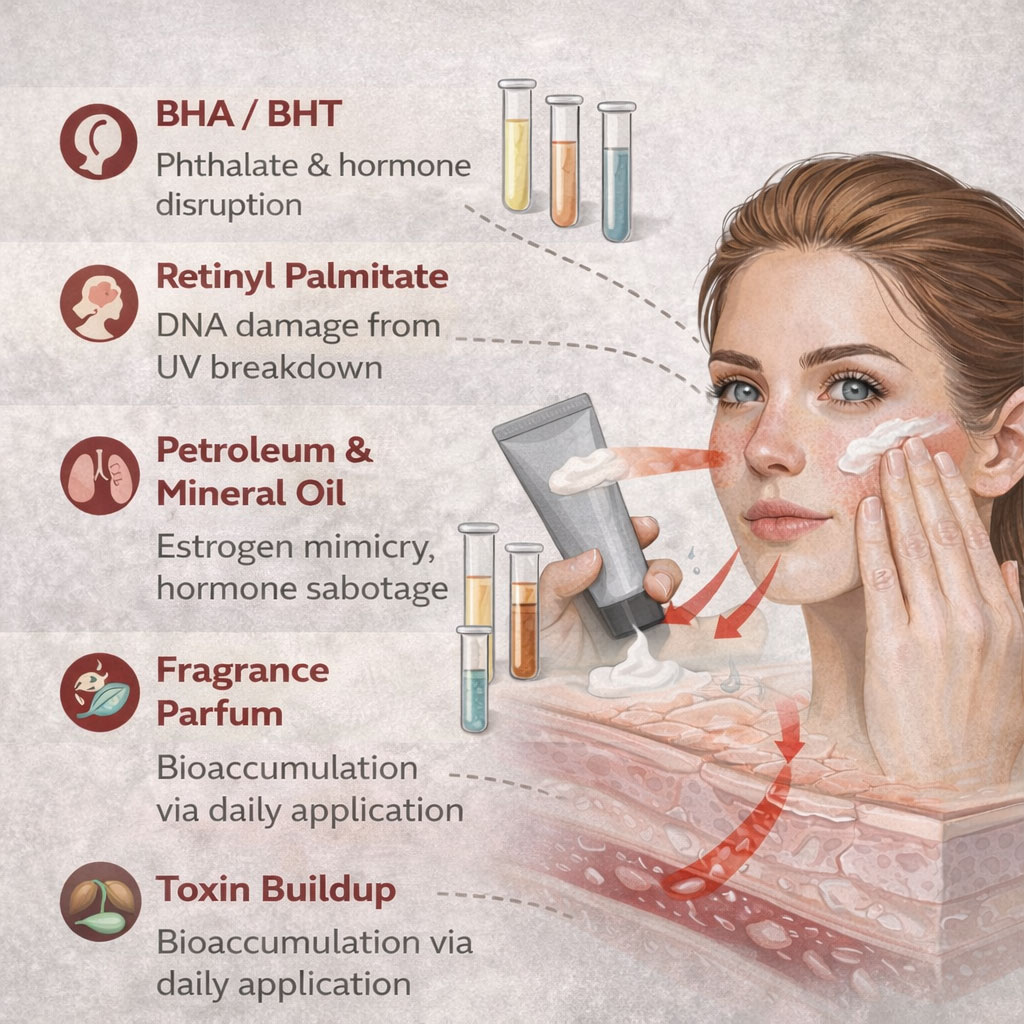
Facial skin is thinner, more vascular, and more permeable than most areas of the body. As shown above, ingredients commonly found in conventional facial moisturizers can pass through the skin barrier and enter underlying tissue. When applied daily, this repeated exposure creates a cumulative chemical load — especially concerning for endocrine disruptors, petroleum byproducts, and unstable vitamin A derivatives.
Illustration for educational purposes based on published toxicology and dermatological research.
This same barrier-disruption pattern appears across other personal care categories, including hand creams and hand soaps, which is why swapping individual products without addressing formulation quality rarely solves chronic skin issues.
The Swaps That Solves the Moisturizer Cancer Risk Problem
The right Facial Moisturiser shouldn’t just be safe. Instead, it should actively optimize your skin’s health by supporting its natural barrier function without introducing systemic irritants. My core criteria for a compliant and effective swap are definitive. Ingredients must have a clear functional role, be non-toxic, and support, not obstruct, the skin’s physiology.
Now, this is where the real work happens. Based on the Scientific criteria I just laid out, my team and I have compiled a shortlist. We rigorously filtered out the greenwashing. Furthermore, we tested for verified third-party lab reports (ensuring no contamination with heavy metals or phthalates). We confirmed inventory and availability. Consequently, we only move forward with swaps that meet our high-bar standard.
Ready for Our Facial Moisturizer Vetted Picks?
If you’re ready to stop reading complex data and simply implement the perfect solution for your sensitive skin, click below to see the only comprehensive Facial Moisturizer recommendations we trust.
Nia Montoro-Cortés’s Final Thoughts
Choosing a clean Facial Moisturizer is one of the most impactful personal care swaps you can make. It’s an investment in the health of your largest organ and a commitment to reducing your daily toxic load. Therefore, choose data over department store marketing.
Frequently Asked Questions:
A1: The concern regarding a moisturizer cancer risk is linked to specific ingredients like BHA, BHT, and contaminated petroleum derivatives. BHA is classified by the National Toxicology Program as “reasonably anticipated to be a human carcinogen.” Furthermore, if mineral oils are not highly refined, they may contain Polycyclic Aromatic Hydrocarbons (PAHs), which are documented carcinogens that can be absorbed through the thin skin on the face.
A2: Many conventional moisturizers contain phthalates (often hidden under the term “fragrance” or “parfum”) and synthetic antioxidants like BHA and BHT. These chemicals are known endocrine disruptors that mimic or interfere with the body’s natural hormones. My research into trace plasticizers indicates that daily application to the face—where absorption is high—leads to a measurable cumulative dose that can disrupt hormonal signaling.
A3: While a popular anti-aging ingredient, Retinyl Palmitate has come under scientific scrutiny. Data suggests that when applied to the skin and exposed to UV light, it may accelerate the development of skin tumors and lesions. For those prioritizing long-term health and skin DNA integrity, I recommend avoiding this specific Vitamin A derivative in daytime moisturizers to eliminate this unnecessary risk factor.
A4: To avoid “greenwashing,” ignore vague terms like “natural” and look for Value through ingredient transparency. A safe moisturizer should prioritize skin-identical ingredients like ceramides or hyaluronic acid and use organic plant oils (Jojoba, Argan) instead of petroleum. I look for products that are third-party verified to be free of heavy metals and phthalates, ensuring the formulation supports, rather than suffocates, the skin’s lipid barrier.
Compliance Note: The content within this article is curated and vetted by the Swap The Toxins editorial team, aligning with the strict standards and expertise of our dedicated product experts.
Continue Your Non-Toxic Swap Journey…
Ready to transform more areas of your life? We have comprehensive guides for both home and body product categories, plus our non-toxic gifting hub:
- Non-Toxic Home Swaps: See vetted reviews for Non-Toxic Home Swaps for a cleaner living space.
- Non-Toxic Body Swaps: See vetted reviews for your Non-Toxic Body Care routine
- The Non-Toxic Gift Guide Hub: Explore our curated selections for every occasion, ensuring your high-value gifts are always safe and sustainable.
- For Our Full Library: Explore all articles, guides, and insights in the Swap The Toxins Blog.